

Occupy/Accrue is an occupancy shares housing cooperative that solves the problem of renters throwing money away while being locked out of homeownership. Members pay monthly housing costs similar to rent, but approximately 50-60% of each payment becomes "Occupancy Shares" in their personal savings account (worth up to $1.00 per share). After 3 years, a member could accumulate $20,000-$30,000 in real savings—enough for a down payment on a house. The system offers three pathways: (1) cash out and use savings for homeownership, (2) stay long-term and reach "max threshold" where monthly costs drop to just variable costs, or (3) move freely between units as life changes while keeping all accumulated shares. Shares don't appreciate with property values (capped at $1.00), which maintains permanent affordability for future members while still building substantial wealth for current members. The model serves self-employed workers, gig economy participants, credit-challenged individuals, and anyone needing housing flexibility who can't access traditional mortgages but want to build something more than zero. Properties are owned by Pathing Public Benefit Corporation (allowing investor capital) and leased to the cooperative, which operates democratically with one member, one vote governance, creating a true alternative between renting and buying.
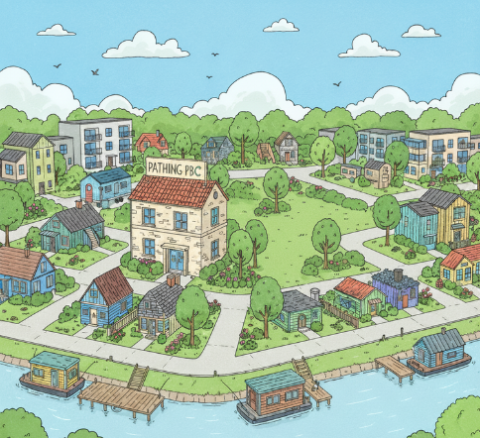
Pathing PBC is the property acquisition and asset management engine that makes large-scale cooperative housing financially viable. As a public benefit corporation, it can raise capital from impact investors (through Class A shares) who want market-rate or modest returns while supporting affordable housing—solving the cooperative's biggest barrier to growth. Pathing acquires and holds residential properties, assumes mortgage debt, and manages property financing, which individual cooperative members couldn't do collectively. The PBC structure provides legal liability separation, protecting cooperative members from property-level risks while protecting property assets from cooperative operational issues. Through long-term master leases to the cooperative, Pathing ensures stable, predictable income while guaranteeing members affordable, secure housing with built-in protections. The Class B shares issued to the cooperative create a direct equity link—when the co-op's members accumulate Occupancy Shares, they're building claims on real property value held by Pathing, not just internal co-op credits. This structure enables rapid scalability while the cooperative maintains democratic control and mission integrity. Pathing can also negotiate bulk financing, achieve economies of scale in property management, and provide professional asset management that small cooperatives struggle to access.
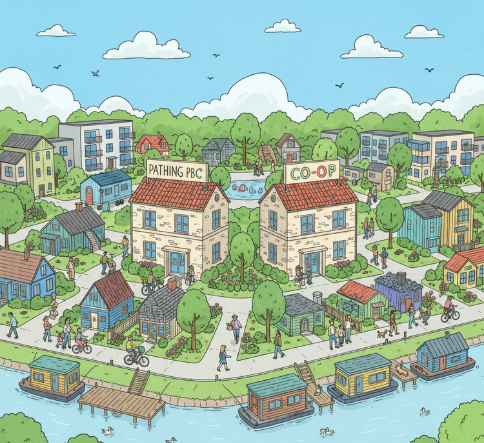
The two-entity structure creates powerful benefits: The Public Benefit Corporation (Pathing) can raise investor capital to acquire properties while maintaining mission alignment, solving the cooperative's biggest challenge—accessing capital for growth without compromising member control. Meanwhile, the Housing Cooperative provides democratic governance and protects member equity through long-term master leases, ensuring properties serve residents rather than investor profit. This separation also creates legal liability protection for both entities and allows tax optimization (PBC can be structured for investor returns, Co-op potentially qualifies for 501(c) or 521 tax benefits). Most importantly, the Class B shares owned by the Co-op directly link member Occupancy Shares to underlying property equity, so when members accumulate shares through housing payments, they're building real wealth tied to tangible assets—not just paper promises. The structure enables scalability (acquire properties quickly with investor capital) while maintaining affordability and member control (cooperative governance prevents mission drift), creating a sustainable model that can grow to serve thousands of members across multiple properties without losing its cooperative soul.